Spinal Muscular Atrophy
Definition And Pathophysiology
- Spinal muscular atrophy (SMA) is a progressive, degenerative disease of the motor neurons beginning in fetal life or infancy.
- The disease is characterized by symmetrical muscular atrophy resulting from the degeneration of anterior horn cells in the spinal cord and brain stem nuclei.
- When brain stem involvement predominates, it is termed Fazio-Londe disease.
- It is a lower motor neuron disorder that selectively spares upper motor neurons, extraocular muscles, and sphincters in most cases.
- The pathological hallmark is progressive denervation of muscle, leading to the formation of giant motor units and subsequent muscle atrophy.
- Cognitive function and intelligence remain completely normal.
Epidemiology
- Spinal muscular atrophy is the most common genetic disorder affecting anterior horn cells in children.
- It is the second most frequent autosomal recessive disorder after cystic fibrosis.
- The incidence is estimated at 1 in 6000 to 10000 live births, with a carrier frequency of approximately 1 in 40 to 60.
Genetics And Molecular Basis
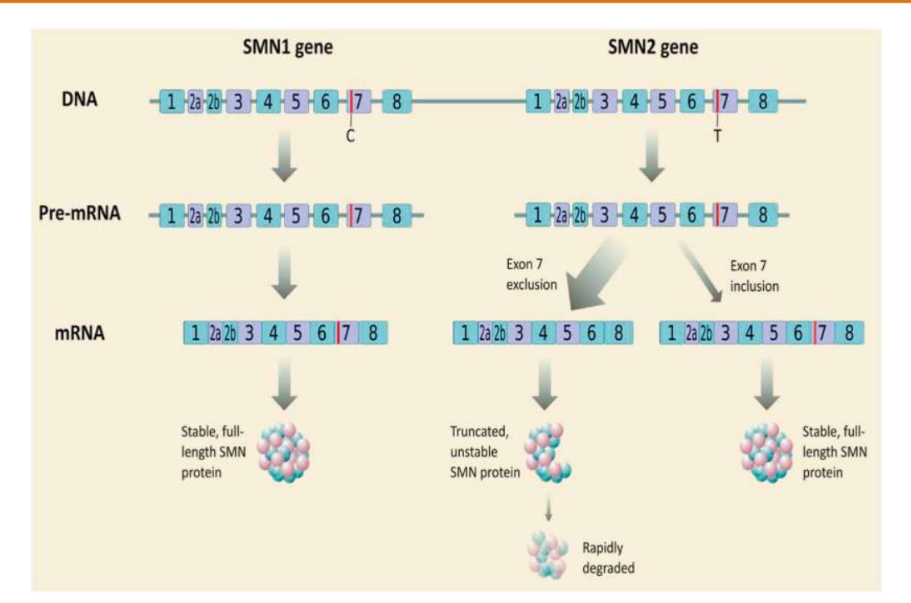
- Inheritance is autosomal recessive, caused by a homozygous deletion or mutation in the survival motor neuron 1 (SMN1) gene on chromosome 5q13.2.
- The SMN1 gene codes for a full-length, functional SMN protein required for motor neuron survival.
- The SMN complex plays a role in the formation of small nuclear ribonucleoproteins, essential for pre-mRNA splicing in motor neurons.
- A homologous backup gene, SMN2, is present in all individuals but contains a translationally silent C to T base change in exon 7.
- This substitution alters splicing, causing the majority of SMN2 transcripts to lack exon 7, resulting in a truncated, unstable, and rapidly degraded protein.
- SMN2 produces only 10-20% of functional SMN protein.
- Disease severity correlates inversely with SMN2 gene copy number; higher SMN2 copies produce more functional SMN protein, leading to milder phenotypes.
Clinical Classification And Features
The disease is classified into five types based on the age of onset and maximum motor milestones achieved.
| SMA Type | Eponym | Age Of Onset | Motor Milestones Achieved | Clinical Features And Lifespan |
|---|---|---|---|---|
| Type 0 | Prenatal SMA | Prenatal | None | Decreased fetal movements, congenital contractures (arthrogryposis), severe respiratory distress, heart defects. Lifespan <6 months. |
| Type 1 | Werdnig-Hoffmann Disease | <6 months | Head control never achieved; never sit unaided | Severe generalized weakness (proximal > distal, lower > upper limbs), frog-leg posture, absent reflexes, tongue fasciculations, paradoxical breathing, bell-shaped chest. Lifespan <2 years without intervention. |
| Type 2 | Dubowitz Disease | 6-18 months | Sit independently, never walk | Progressive weakness, fine tremor of outstretched hands (polyminimyoclonus), absent reflexes, progressive scoliosis. Lifespan extends into school years or adulthood. |
| Type 3 | Kugelberg-Welander Disease | >18 months | Walk independently | Proximal weakness (frequent falls, difficulty climbing stairs), waddling gait, calf hypertrophy (mimics muscular dystrophy). Normal lifespan. |
| Type 4 | Adult SMA | 2nd or 3rd decade | Ambulatory | Mild proximal weakness. Normal life span. |
Differential Diagnosis
Spinal muscular atrophy type 1 and 2 present as floppy infant syndrome with profound weakness.
| Category | Examples | Distinguishing Features |
|---|---|---|
| Spinal Cord Disorders | Neoplasms, poliomyelitis | Sensory level, bowel/bladder involvement, upper motor signs. |
| Other Motor Neuron Disorders | Juvenile amyotrophic lateral sclerosis, Brown-Vialetto-Van Laere, SMARD1 | Additional features like ataxia, hearing loss, respiratory distress type 1. |
| Neuromuscular Junction | Botulism, congenital myasthenic syndromes, transient neonatal myasthenia | Fatigable weakness, ptosis, ophthalmoplegia, decremental response on repetitive stimulation. |
| Myopathies | Congenital myopathies, Pompe disease, congenital muscular dystrophies | Often have elevated CPK, myopathic electromyography, no fasciculations, preserved reflexes early. |
| Neuropathies | Congenital hypomyelinating neuropathy | Presents with distal weakness, sensory involvement. |
Investigations And Diagnosis
Genetic Testing (Gold Standard)
- Targeted variant analysis utilising quantitative polymerase chain reaction (PCR) or multiplex ligation-dependent probe amplification (MLPA) is the first-line test.
- Detection of the homozygous deletion of SMN1 exon 7 provides definitive diagnosis with 95-98% sensitivity.
- Testing also determines SMN2 copy number for prognostic evaluation.
Laboratory And Electrophysiological Findings
- Creatine Phosphokinase (CPK): Normal or mildly elevated (usually less than 10 times the upper limit of normal), helping distinguish spinal muscular atrophy from muscular dystrophies.
- Electrocardiogram (ECG): May demonstrate a baseline tremor artifact on lead II representing somatic muscle fibrillations.
- Electromyography (EMG): Shows features of active denervation, spontaneous fibrillation potentials, and giant motor unit action potentials. Nerve conduction velocities are typically normal.
Muscle Biopsy
- Reserved for cases with equivocal genetic testing.
- Displays a characteristic perinatal denervation pattern with groups of giant type I fibers intermixed with fascicles of severely atrophic fibers of both types.
Management And Disease-Modifying Therapies
Supportive Care
- Respiratory: Non-invasive ventilatory support, airway clearance techniques, and aggressive management of chest infections.
- Gastrointestinal/Nutritional: Evaluation for dysphagia, reflux, and constipation. Gastrostomy tube insertion may be required to optimize caloric intake and prevent aspiration.
- Orthopedic: Physiotherapy, postural support, and early surgical intervention for progressive kyphoscoliosis or contractures.
Disease-Modifying Therapies
Recent advances target the underlying genetic defect, significantly altering the natural history of the disease.
| Drug Name | Mechanism Of Action | Route And Dosing | Target Population And Adverse Events |
|---|---|---|---|
| Nusinersen (Spinraza) | Antisense oligonucleotide (ASO). Modifies SMN2 pre-mRNA splicing to promote inclusion of exon 7, producing full-length functional SMN protein. | Intrathecal. Loading doses followed by maintenance doses every 4 months. | Approved for all SMA types and ages. Adverse events include lumbar puncture-related issues, thrombocytopenia, and proteinuria. |
| Onasemnogene Abeparvovec (Zolgensma) #recent | Gene replacement therapy. Utilises adeno-associated viral vector (AAV9) to deliver a fully functional copy of the SMN1 gene into motor neurons. | Intravenous. Single, one-time dose. | Approved for children |
| Risdiplam (Evrysdi) | Small molecule splice modifier. Orally bioavailable compound promoting exon 7 inclusion in SMN2 pre-mRNA. | Oral. Administered daily. | Approved for patients |
Prognosis And Genetic Counseling
- Without disease-modifying therapy, type 1 is fatal by 2 years, while type 2 survival extends to the 2nd or 3rd decade.
- With targeted therapies and multidisciplinary care, survival and motor function improve dramatically, particularly when initiated presymptomatically.
- Genetic counseling must be offered; the condition carries an autosomal recessive 25% recurrence risk for future siblings.
- Antenatal diagnosis is possible via chorionic villus sampling between the 10th and 12th gestational weeks.