Hearing Assessment In Children
Screening Guidelines And Principles
- Significant hearing loss affects 1-3 per 1000 newborns.
- Universal neonatal hearing screening strictly recommended for all newborns.
- Early identification prevents severe speech and language developmental delays.
- Follow established '1-3-6' rule for optimal developmental outcomes.
- Complete initial neonatal screening by 1 month of age.
- Ensure definitive diagnostic testing by 3 months.
- Initiate therapeutic intervention by 6 months.
Objective Electrophysiologic Evaluation
Otoacoustic Emissions
- Evaluates cochlear outer hair cell functional integrity.
- Represents quick, inexpensive primary neonatal screening modality.
- Elicits absent response if hearing loss exceeds 30-40 decibels.
- Accuracy frequently compromised by middle ear effusion or external canal obstruction.
Auditory Brainstem Response
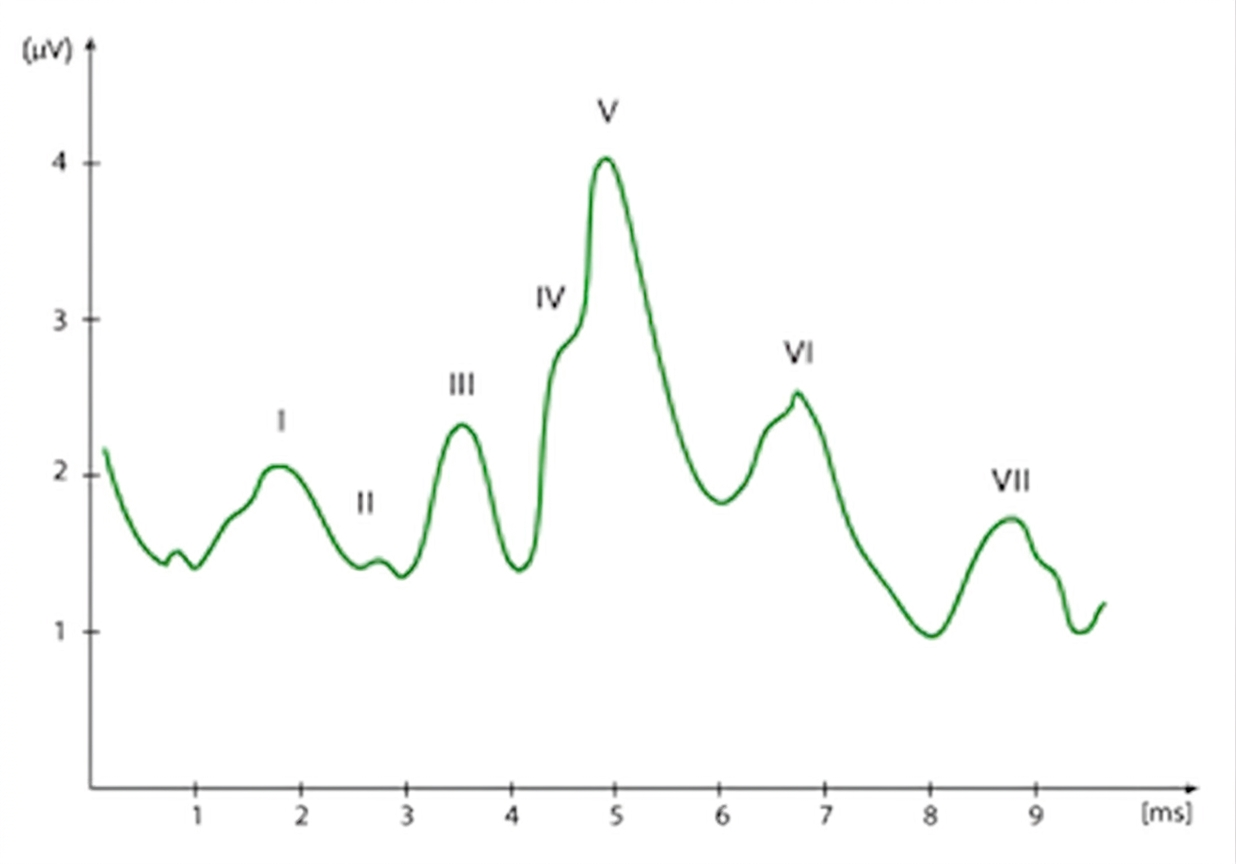
- Measures synchronized neuronal electrical discharges from cochlea, auditory nerve, and brainstem.
- Records 5 to 7 distinct electrical waveforms correlating to specific neural generators.
- Provides definitive threshold estimation and central nervous system auditory pathway evaluation.
- Essential diagnostic tool for infants, uncooperative children, and cases failing otoacoustic emission screens.
- Remains completely unaffected by patient sedation or general anesthesia.
Acoustic Immittance Testing
- Assesses functional status and compliance of tympanic membrane and middle ear structures.
Tympanometry Profiles
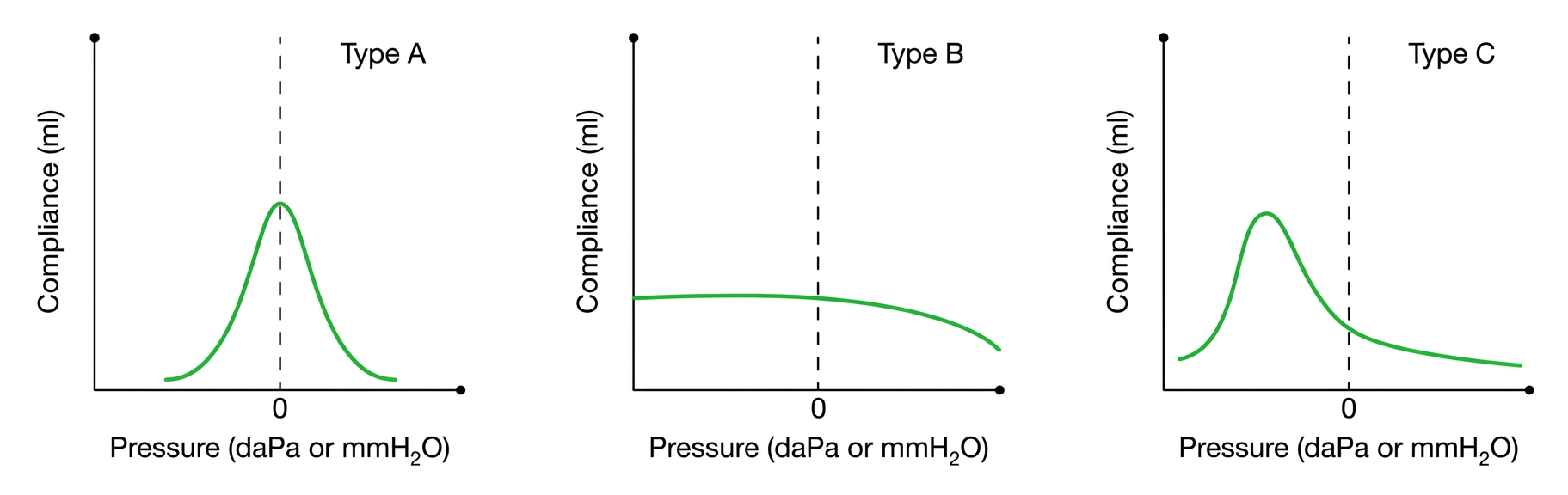
| Curve Type | Characteristic Findings | Clinical Significance |
|---|---|---|
| Type A | High admittance, steep gradient, normal peak pressure. | Normal middle ear status. |
| Type B | Flat tracing, low admittance, completely absent peak. | Indicates middle ear effusion if volume low; suggests perforation or patent tympanostomy tube if volume high. |
| Type C | Obtuse-angled peak, significantly negative middle ear pressure. | Indicates eustachian tube dysfunction and transitional middle ear pathology. |
Acoustic Reflex Threshold
- Measures reflexive stapedius muscle contraction elicited by high-intensity sound.
- Assesses sensorineural hearing thresholds alongside cranial nerve VII and VIII reflex arc integrity.
Behavioral And Age-Specific Audiometry
- Assessment techniques evolve alongside developmental age and cognitive maturity.
| Modality | Target Age | Testing Mechanism |
|---|---|---|
| Behavioral Observation Audiometry | Under 5 months | Relies on unconditioned reflexive responses (altered sucking, crying cessation, pupillary dilation) to complex uncalibrated sounds. |
| Visual Reinforcement Audiometry | 6 to 30 months | Conditions child to turn head toward sound stimulus paired with animated mechanical or video visual reinforcer. |
| Play Audiometry | 30 months to 5 years | Employs conditioned motor activities (dropping blocks, placing rings) upon hearing specific tonal signals. |
| Pure-Tone Audiometry | Over 4 to 5 years | Standard earphone assessment across 250 to 8000 Hertz; compares air conduction against bone conduction. |
Speech Audiometry
- Speech-recognition threshold identifies lowest intensity allowing 50 percent accurate word recognition.
- Utilizes specific spondee words (two-syllable words carrying equal stress).
- Validates pure-tone averages and estimates practical communication potential.
High-Risk Indicators Requiring Close Monitoring
- Severe prematurity with birth weight below 1500 grams.
- Hyperbilirubinemia requiring emergent exchange transfusion.
- Mechanical ventilation utilization exceeding 5 days.
- History of bacterial meningitis or recurrent severe otitis media.
- Substantial ototoxic medication exposure (prolonged aminoglycosides, loop diuretics).
- Craniofacial anomalies including cleft palate and structural auricular malformations.
- Intrauterine gestational infections (cytomegalovirus, rubella, syphilis, toxoplasmosis).
- Stigmata indicating genetic syndromes associated with deafness (Waardenburg, Alport, Pendred, Usher).