Home
/
Emergencies
/
Approach to Children with Burns
Approach to Children with Burns
Algorithm
%%{init: { "theme": "dark", "themeVariables": { "lineWidth": "3px", "lineColor": "#000000" } }}%%
graph TD
classDef start fill:#1b5e20,color:#ffffff,stroke:#66bb6a;
classDef step fill:#0d47a1,color:#ffffff,stroke:#42a5f5;
classDef decision fill:#4a148c,color:#ffffff,stroke:#ab47bc;
classDef alert fill:#b71c1c,color:#ffffff,stroke:#ef5350;
A(Pediatric Burn ):::start
B1[Prehospital Care Primary Survey Special Injuries Minor Burns Major Burns Airway Management Circulation Access Calculate Severity Burn Center Required }:::decision
D3 --> E1
F1[Burn Center Transfer Standard Care Resuscitation Nutritional Support Topical Agents Surgical Care Inhalation Injury Electrical Injury Epidemiology And General Principles
Unintentional fire-related injuries account for approximately 10% of unintentional injury-related pediatric deaths.
Children face higher mortality risk compared to adults.
Scald burns represent leading hospitalization cause in children under 4 years, comprising 65% of admissions.
Flame burns manifest most frequently in children over 5 years.
Child abuse contributes to approximately 18% of burn injuries.
Abuse presents typically as glove or stocking distribution, isolated deep trunk burns, or circular cigarette burns.
Loss of skin integrity precipitates hypothermia, massive fluid loss, and environmental microbial invasion.
Prehospital And Emergency First Aid
Wrap victim in blanket immediately at scene.
Extinguish flames by rolling victim on ground.
Avoid running with burning clothes.
Extricate safely to airy environment.
Prevent continued inhalation of carbon monoxide and cyanide.
Remove smoldering clothing immediately.
Remove constricting jewelry to prevent vascular compromise during edema phase.
Irrigate minor burns under 10% TBSA with cool tap water for 10-20 minutes.
Cold water application strictly contraindicated for burns exceeding 15% TBSA due to severe hypothermia risk.
Avoid home remedies including grease, soda, butter, oil, powder, or toothpaste.
Cover wound strictly with clean dry sheeting or sterile dressing.
Primary Survey And Acute Resuscitation
Airway And Breathing Management
Administer 100% oxygen immediately for facial burns, singed hair, carbonaceous sputum, or suspected smoke inhalation.
Assess airway strictly for laryngeal edema, stridor, or retractions.
Perform early elective intubation for any evidence of significant airway compromise.
Circulation And Hemodynamics
Obtain intravenous access in non-burned areas preferably.
Utilize burned areas for vascular access if alternative sites remain unavailable.
Place intraosseous line if intravenous access fails emergently.
Replace intraosseous access with central venous line subsequently.
Disability And Exposure Control
Perform rapid neurological assessment evaluating hypoxia or carbon monoxide poisoning.
Expose fully to calculate TBSA accurately.
Assess concurrent injuries thoroughly.
Cover immediately with warmed blankets preventing hypothermia.
Maintain cervical spine precautions for explosion, fall, or high-voltage mechanisms.
Assessment Of Burn Severity
Classification Of Burn Depth
Accurate classification guides treatment and predicts scarring.
Burn Depth Classification
Anatomical Involvement
Clinical Characteristics
Prognosis And Healing
First-Degree Confined strictly to epidermis
Erythematous, dry, painful, lacks blistering.
Heals within one week without scarring.
Second-Degree Epidermis and variable dermis portion
Moist blebs and blisters; mottled pink/white underlying tissue; exquisitely painful.
Superficial heals in 7-14 days; deep requires over 3 weeks, leaving scar.
Third-Degree Complete destruction of epidermis and dermis
Leathery, dry, mottled, non-blanching; insensate center due to destroyed nerve endings.
Cannot regenerate; requires surgical excision and skin grafting.
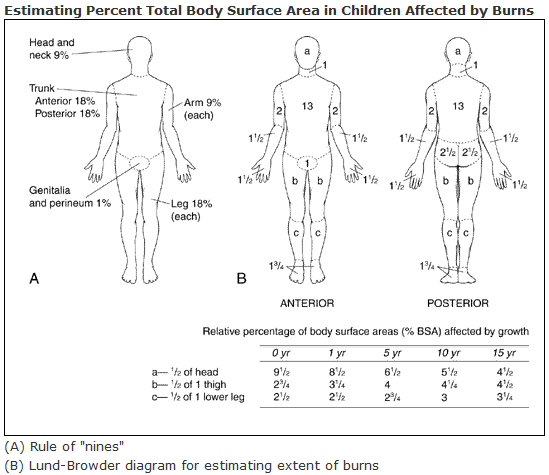
Estimation Of Total Body Surface Area
Rule of nines remains inaccurate for children under 15 years.
Larger head-to-body mass ratio dictates specialized assessment.
Variable extremity growth requires age-specific evaluation tools.
Utilize Lund and Browder chart for accurate pediatric estimation.
Utilize child's palmar surface including fingers for rapid 1% TBSA estimation.
Indications For Burn Center Admission
Appropriate triage minimizes pediatric morbidity and mortality.
Clinical Criteria For Burn Center Referral
Partial-thickness burns involving greater than 10% TBSA.
Full-thickness burns involving greater than 5% TBSA at any age.
Burns involving critical areas: face, hands, feet, genitalia, perineum, or major joints.
Electrical burns including high-tension wire and lightning injuries.
Chemical burns and suspected inhalational injury.
Burn injuries complicated by pre-existing medical conditions.
Concomitant trauma or suspected child abuse/neglect.
Fluid Resuscitation And Hemodynamic Monitoring
Replenish massive fluid losses aggressively.
Maintain adequate end-organ perfusion.
Protect ischemic zone without overloading pediatric circulation.
Initiate rigorous intravenous resuscitation for burns exceeding 10-15% TBSA.
Institute strict urinary catheterization for continuous output monitoring.
Component
Calculation And Administration Guidelines
Resuscitation Volume Volume equals 4 mL multiplied by weight multiplied by percent TBSA burn. Ringer's lactate serves as preferred isotonic crystalloid.
Administration Schedule Infuse half calculated volume during first 8 hours post-injury. Infuse remaining half over subsequent 16 hours.
Maintenance Fluids Required for children under 20 kg. Provide 5% dextrose in normal saline or Ringer's lactate.
Monitoring Targets Maintain urine output above 1 mL/kg/hr for infants. Target 0.5 mL/kg/hr for children over 20 kg.
Hemodynamic Adjustment Protocols
Increase fluid infusion rate by 10% if urine output falls below target.
Decrease infusion rate by 10% if urine output exceeds target.
Recognize tachycardia as unreliable resuscitation marker due to profound hypermetabolism.
Insert central venous lines for reliable volume delivery in burns over 20% TBSA.
Adjust second 24-hour fluids accounting for insensible losses and wound exudation as capillary leak seals.
Analgesia, Sedation, And Nutrition
Pain And Anxiety Management
Implement multimodal pain approach addressing wide intensity fluctuations.
Administer scheduled long-acting opioids for background pain.
Utilize potent short-acting intravenous opioids for procedural pain.
Administer midazolam for procedural anxiolysis.
Schedule gabapentin targeting neuropathic pain.
Anticipate severe hypermetabolic and catabolic state.
Target massive protein intake reaching 2-4 g/kg/day for survival.
Initiate enteral feeding via nasogastric or nasojejunal tube on admission day.
Preserve gastrointestinal mucosal integrity through early enteral feeding.
Calculate infant caloric requirements: 2100 Cal/m2 plus 1000 Cal/m2 burn surface area.
Calculate child caloric requirements: 1800 Cal/m2 plus 1300 Cal/m2 burn surface area.
Wound Care And Topical Antimicrobial Therapy
General Wound Management
Avoid prophylactic systemic antibiotics strictly.
Systemic antibiotics promote resistant pathogens without preventing sepsis.
Rely entirely on local topical antimicrobial agents.
Leave minor burn blisters intact.
Debride ruptured blisters removing devitalized tissue.
Specific Topical Agents
Antimicrobial Agent
Clinical Characteristics And Adverse Effects
0.5% Silver Sulfadiazine Painless application with soothing effect. Limits fluid loss. Adverse effects include transient leukopenia, skin rash, thrombocytopenia.
Mafenide Acetate Exhibits excellent penetration through thick eschar. Agent of choice for deep burns and cartilaginous surfaces. Induces severe application pain and metabolic acidosis.
0.5% Silver Nitrate Provides broad-spectrum coverage for sulfa-allergic patients. Causes gray wound staining. Induces severe electrolyte derangements including hyponatremia and hypokalemia.
Surgical Intervention
Perform prompt decompressive escharotomy for circumferential extremity or truncal burns.
Prevent compartment syndrome and respiratory restriction aggressively.
Execute early surgical excision of eschar for deep burns exceeding 10% TBSA.
Perform autologous skin grafting rapidly to prevent systemic sepsis and optimize functional outcomes.
Management Of Special Burn Injuries
Inhalational Injuries
Suspect inhalation injury in closed-space fires.
Identify singed facial hair, carbonaceous sputum, hoarseness, or altered sensorium.
Confirm carbon monoxide poisoning via elevated carboxyhemoglobin levels.
Administer 100% oxygen immediately.
Oxygen dramatically reduces carbon monoxide elimination half-life from 4 hours to 40 minutes.
Suspect cyanide toxicity with synthetic material combustion.
Administer intravenous hydroxycobalamin 70 mg/kg addressing cyanide toxicity.
Hydroxycobalamin binds cyanide forming stable cyanocobalamin for urinary excretion.
Avoid amyl nitrite and sodium nitrite strictly due to severe methemoglobinemia induction risk.
Electrical Injuries
Anticipate direct contact or arcing mechanisms.
Characterized distinctly by specific entry and exit wounds.
Recognize surface burns severely underestimate deep tissue destruction.
Disconnect patient immediately from power source utilizing non-conductive materials.
Initiate continuous cardiac monitoring due to fatal arrhythmia risk.
Anticipate massive muscle necrosis precipitating myoglobinuria.
Mitigate acute renal failure risk via aggressive fluid resuscitation and forced alkaline diuresis.
Monitor closely for deep compartment syndrome.
Perform urgent fasciotomies and aggressive surgical debridement for necrotic muscle.